The evidence
“Evidence-based.” You hear it a lot in the supplement world. You hear rather less about what it actually means. So let’s explain what we mean by it at Personally, and how the research shapes every formula we make for you.
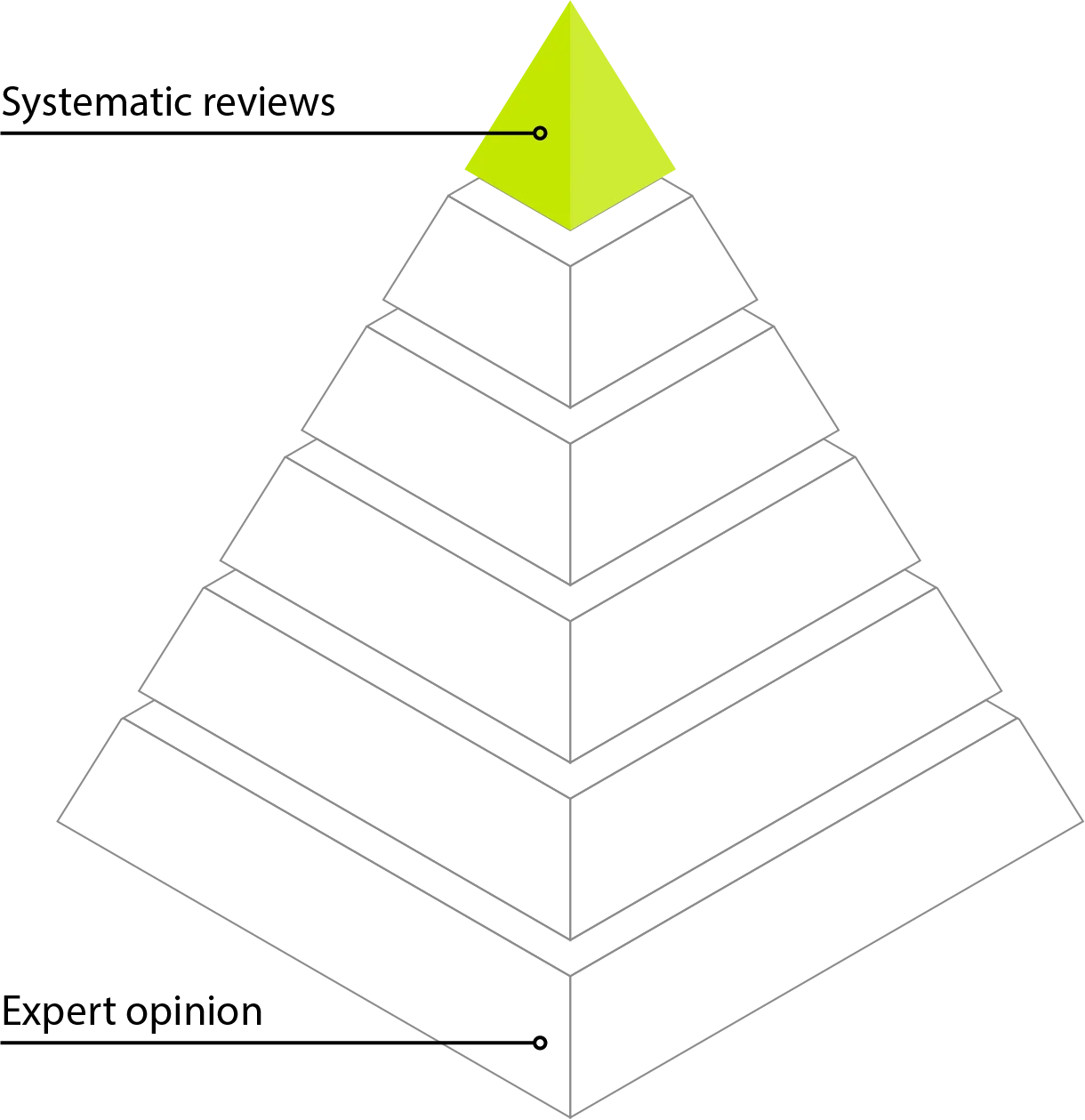
Discover the Evidence Pyramid.
The evidence pyramid helps scientists make sense of different types of research. At the bottom, expert opinions and individual case reports can give researchers something to investigate. Useful starting points, but open to bias. Further up, observational studies follow groups of people over time. Then come randomized controlled trials, comparing a treatment with a placebo or another treatment. At the top, systematic reviews bring together and assess relevant studies, while meta-analyses combine their results. Together, they help us see the bigger picture.
At Personally, when we say “evidence-based”, we’re talking about those upper levels. Systematic reviews, meta-analyses, well-designed randomized controlled trials and well-conducted long-term cohort studies. We look at what the research can reliably tell us. One small study, a promising result in animals or an expert sounding very sure of themselves isn’t enough on its own to change your formula. And when the strongest evidence is missing or mixed? We’d rather wait because guesswork sucks.
Every ingredient has to earn its place.
We’ve screened over 14 million published papers on nutrition and supplement ingredients. We analyze each ingredient, the amount used and the form it takes. Because different forms of the same nutrient can behave very differently in your body. Evidence for an ingredient isn’t enough on its own. It has to support the amount we actually use before it earns a place in our ingredient library.

Something here about all your data

Every body is different
Even twins can have different supplement needs. Age, sex, genetics, diet, activity and medications all play a part. Take vitamin B12. Vegans are more likely to fall short, while older people often absorb less from food. Same nutrient. Different needs. Average doesn't exist. Your Personally formula starts with you.

Everybody changes
You'll always be you. But your body's needs change. Vitamin D levels can fall in winter as sunlight decreases. Training for an event, recovering from illness, entering perimenopause or changing your diet can shift your needs, too. So we recalibrate your Personally formula every 30 days using your latest data.

Everybody’s body has a rhythm
Your body follows an approximately 24-hour circadian rhythm, influencing hormones, digestion and sleep. Chrononutrition suggests nutrient timing matters, too. Vitamin D is better absorbed with food, while some ingredients suit the evening. That's why your Personally formula comes in two parts: a daytime powder and a small evening shot.
It’s not just “expensive pee!”
You might’ve heard that any extra vitamins just pass through you. No harm done. Just expensive pee. But that’s only part of the story. Fat-soluble vitamins, including A, D, E and K, can stay in your body and build up over time. Even water-soluble vitamins aren’t harmless in any amount. Too much vitamin B6 over long periods, for example, has been linked to nerve damage in the hands and feet (Schaumburg et al., 1983).
More isn’t always better. Two major clinical trials, ATBC and CARET, found higher rates of lung cancer among smokers and people exposed to asbestos who took high amounts of beta-carotene in supplements, compared with those given a placebo (ATBC Study Group, 1994; Omenn et al., 1996). Something that’s safe in food can behave very differently in the amounts found in supplements. That’s why your Personally formula starts with what the evidence supports for you. The right ingredients, in the right amounts, at the right time.

What else are you taking?
Supplements and prescription medications don’t always work well together. And you might not know which combinations to watch for. Take St. John’s wort. It speeds up a liver enzyme called CYP3A4, which helps break down many prescription drugs (Markowitz et al., 2003). That can make some medications, including certain oral contraceptives, less effective. Not good. Vitamin K can also reduce the effect of warfarin, a blood thinner. These interactions are well documented but they’re easy to miss if nobody checks.
So we check. Every medication you tell us about is screened against every ingredient before we make your Personally formula.
If the evidence shows a combination could cause harm at the amount we use, that ingredient stays out. We use evidence from human studies, rather than theory alone, to make those decisions. Because leaving out a useful ingredient needs a good reason.
And of course, always talk to your doctor or pharmacist about the supplements you take.

Sources
- Alpha-Tocopherol, Beta Carotene Cancer Prevention Study Group (1994) 'The effect of vitamin E and beta carotene on the incidence of lung cancer and other cancers in male smokers', New England Journal of Medicine, 330(15), pp. 1029-1035. doi:10.1056/NEJM199404143301501.
- Markowitz, J.S., Donovan, J.L., DeVane, C.L., Taylor, R.M., Ruan, Y., Wang, J.S. and Chavin, K.D. (2003) 'Effect of St John's wort on drug metabolism by induction of cytochrome P450 3A4 enzyme', JAMA, 290(11), pp. 1500-1504. Available at: https://jamanetwork.com/journals/jama/fullarticle/197306.
- Omenn, G.S., Goodman, G.E., Thornquist, M.D., Balmes, J., Cullen, M.R., Glass, A., Keogh, J.P., Meyskens, F.L., Valanis, B., Williams, J.H., Barnhart, S., Cherniack, M.G., Brodkin, C.A. and Hammar, S. (1996) 'Risk factors for lung cancer and for intervention effects in CARET, the Beta-Carotene and Retinol Efficacy Trial', Journal of the National Cancer Institute, 88(21), pp. 1550-1559. doi:10.1093/jnci/88.21.1550.
- Schaumburg, H., Kaplan, J., Windebank, A., Vick, N., Rasmus, S., Pleasure, D. and Brown, M.J. (1983) 'Sensory neuropathy from pyridoxine abuse: a new megavitamin syndrome', New England Journal of Medicine, 309(8), pp. 445-448. doi:10.1056/NEJM198308253090801.

Adaptive supplements built around your lifestyle.
Personally adaptive supplements, precisely recalibrated every month to keep pace with your body's unique rate of change.